Binance is the largest crypto exchange in the world. By almost every volume metric, it is the default answer when someone asks where to trade. So when we set out to compare BYDFi against Binance, we were not expecting BYDFi to win across the board — and it doesn’t. But what we found was more interesting than a simple size comparison. On several dimensions that matter to a large and growing segment of traders, BYDFi has built a more capable platform.
Here is what we found when we looked at both exchanges across fees, leverage, copy trading, on-chain access, security, and overall user experience.
Quick Comparison: BYDFi vs Binance at a Glance
| Feature | BYDFi | Binance |
| Founded | 2020, Singapore | 2017 |
| Spot Pairs | 1,000+ | 490+ coins, 1,889 pairs |
| Futures Contracts | 500+ | 530–643 |
| Spot Fees (Maker/Taker) | 0.10% / 0.10% | 0.10% / 0.10% |
| Futures Fees (Maker/Taker) | 0.02% / 0.06% | 0.02% / 0.05% |
| Max Leverage | 200x | 125x |
| KYC Required | No | Yes (mandatory) |
| Copy Trading | 3 engines (CEX + Same-Block + Smart Money) | Standard only |
| On-Chain DEX | MoonX (Solana, BNB Chain) — 500,000+ tokens | Web3 Wallet (30+ chains, separate product) |
| Crypto Card | Visa (Apple Pay, Google Pay, PayPal) | Visa — EEA primarily, up to 8% BNB cashback |
| Demo Account | 50,000 USDT | 3,000 USDT |
About BYDFi
BYDFi launched in April 2020 as BitYard and rebranded in January 2023. Based in Singapore, it now serves over one million registered users across 190+ countries. The platform covers spot trading, perpetual futures, three distinct copy trading engines, four trading bot types, and MoonX — a hybrid on-chain trading module launched in April 2025.
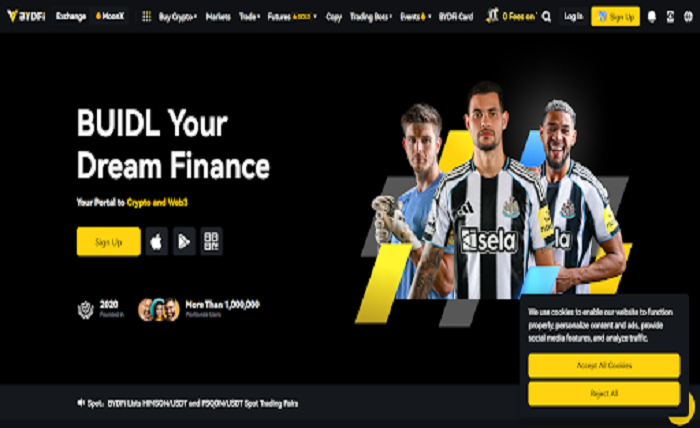
In August 2025, BYDFi was announced as the official crypto exchange partner of Newcastle United Football Club, which is owned by Saudi Arabia’s Public Investment Fund (PIF). The partnership is one of the more visible signals that the platform is investing in long-term brand credibility at a level beyond typical exchange marketing. BYDFi has also received Forbes Top 10 Global Crypto Exchange recognition (December 2023), Forbes Best Crypto Exchange in Canada (January 2026), Best All-in-One Platform at Crypto Expo Europe 2026, and Best CEX by BeInCrypto community vote. It has recorded zero security breaches since launch.
About Binance
Binance was founded in 2017 and currently holds approximately 41.68% of global spot market share, making it the world’s largest crypto exchange by trading volume. With 300 million+ registered users and $34 trillion in total trading volume reported for 2025, its scale is in a different category from any competitor. Its product ecosystem spans spot, futures, options, margin trading, Earn, Launchpad, and the Binance Alpha 2.0 early-stage token platform.
That scale comes with context. In November 2023, Binance settled with the U.S. Department of Justice, CFTC, and Treasury Department for $4.3 billion over AML violations — the largest regulatory penalty in crypto history. Founder Changpeng Zhao entered a guilty plea as part of the settlement. In October 2025, a USDe oracle vulnerability on the platform triggered a BTC price crash from $124,800 to $80,000, causing mass liquidations. Users reported being unable to execute stop-loss orders during the event, and Binance’s subsequent compensation offer was widely criticized as inadequate. These are not minor footnotes; they are material events in any honest platform evaluation.
Fees: Nearly Identical on the Surface, Different in Practice
Both exchanges charge 0.10% maker and 0.10% taker on spot trades at the base tier. Futures fees are also close: BYDFi charges 0.02% maker / 0.06% taker; Binance charges 0.02% maker / 0.05% taker. Binance’s futures taker fee is 0.01% lower, which is a real difference for high-frequency traders, but a marginal one at most trading volumes.
Where the comparison shifts is in the total cost picture. Binance’s fee discounts require holding BNB tokens, which introduces price exposure to a third asset. Its credit card deposit fee is 2%, and the platform takes a 10% commission on staking rewards — costs that do not appear in the headline fee table. BYDFi’s fee structure has no token dependencies and no comparable hidden costs. For traders who want predictable fees without maintaining an external token balance, BYDFi’s structure is cleaner.
At VIP levels, Binance’s fee structure becomes aggressive — VIP 9 futures maker drops to 0.00825% — but this requires trading volumes that are not relevant to the majority of retail users. For most traders, the fee difference between the two platforms is negligible on a per-trade basis.
Leverage: 200x vs 125x, and No Restrictions on Day One
BYDFi offers up to 200x leverage on perpetual futures contracts. Binance caps at 125x on BTC/USDT and ETH/USDT, with most altcoin pairs limited to 50–75x. Beyond the ceiling difference, Binance restricts new users to a maximum of 20x leverage for the first 60 days after account creation. BYDFi has no such onboarding restrictions — a new user has the same access as a veteran from day one.
In practical terms, 200x leverage means a 0.5% adverse price move results in liquidation. Very few traders operate near that ceiling in real conditions. But for experienced derivatives traders who have their own risk frameworks and want maximum capital efficiency, the higher ceiling and absence of onboarding gates are meaningful features.
BYDFi’s 50,000 USDT demo account — versus Binance’s 3,000 USDT — also makes a practical difference. A 50,000 USDT demo environment allows traders to test realistic position sizes and leverage settings before committing real capital. Binance’s 3,000 USDT demo restricts what strategies can be meaningfully tested.
KYC: Optional vs Mandatory
This is one of the clearest functional differences between the two platforms. BYDFi does not require mandatory KYC. Users can register, fund their account, and begin trading within minutes, with a daily withdrawal limit of 6 BTC without any identity verification. Optional KYC increases limits further.
Binance requires mandatory KYC before any trading can take place. The verification process can take anywhere from a few hours to several days, with delays frequently reported during high-traffic periods. For traders who prioritize privacy, operate in regions with limited ID infrastructure, or simply want to start quickly, BYDFi’s no-KYC policy removes a barrier that Binance maintains as a hard requirement.
Copy Trading: Where BYDFi Has Built a Genuine Advantage
Copy trading is the category where the gap between BYDFi and Binance is most pronounced, and it is worth examining in detail. Binance offers standard copy trading: users select a signal provider and the platform replicates positions proportionally. It works, and Binance has the user base to attract a broad range of signal providers. But the architecture is fundamentally a one-engine system.
BYDFi has built three distinct copy trading engines, each designed for a different user profile and a different market environment.
Smart Copy Trading is the CEX-based engine. Users select from signal providers ranked by historical return, drawdown rate, and trade frequency. The minimum investment is $10. Positions run with customizable take-profit and stop-loss parameters, and multiple independent strategies can operate simultaneously through dedicated sub-accounts. This is the starting point for most users — a structured, low-friction way to access professional trading strategies on perpetual futures.
Same-Block Copy Trading, running through MoonX, is the technical differentiator. In traditional on-chain copy trading, the follower’s order is placed after the lead trader’s order is confirmed, creating a latency gap that translates into a different entry price — sometimes significantly so in fast-moving markets. BYDFi’s same-block execution places both orders within the same blockchain confirmation block, eliminating that gap. Entry prices are near-identical. The engine also includes anti-MEV protection to prevent front-running and sandwich attacks, trailing take-profit, automated stop-loss, and a Turbo Wallet achieving millisecond-level transaction response. This is not a marginal improvement over standard copy trading — it solves a structural problem that has made on-chain copy trading unreliable on other platforms.
Smart Money Tracking operates as an intelligence layer. It monitors identified whale wallet addresses across Solana and BNB Chain in real time, tracking four position states: opening, adding, reducing, and closing. Users can add wallets to a watchlist with push notifications for new trades and configure automated replication. A leaderboard displays high-yield wallets filtered by 7-day and 30-day performance, with position concentration data and average buy-in costs visible. It turns passive on-chain monitoring into an automated trading strategy without requiring any manual order management.
Binance does not offer same-block copy trading or smart money tracking. For traders who want copy trading as a serious strategy — particularly those interested in on-chain markets — BYDFi’s triple-engine system operates in a different category.
On-Chain Trading: MoonX vs Binance Web3 Wallet
Both platforms have extended into on-chain trading, but the design philosophy differs fundamentally.
Binance’s Web3 Wallet is a self-custodial product supporting 30+ blockchains and 100+ dApps. It is a capable standalone wallet with cross-chain bridge and swap functionality. However, it is architecturally separate from the core exchange. A Binance user who wants to trade on-chain must switch into a different context, manage a separate wallet environment, and handle the usual self-custody considerations.
BYDFi’s MoonX is built directly into the main platform interface. From the same account and balance used for spot and futures trading, users can access over 500,000 tokens on Solana and BNB Chain without any separate wallet setup, seed phrase management, or browser extensions. Login via email, phone, Google, or Apple is sufficient. The same risk management tools — stop-loss, take-profit, trailing orders — work across both CEX and on-chain positions.
MoonX also tracks the complete token lifecycle. Newly deployed contracts at near-zero market cap are surfaced in real time alongside tokens approaching full liquidity and tokens at launch — giving traders visibility into on-chain activity at stages that never appear on a centralized exchange. Dynamic leaderboards covering the New Token List, Hot List, and Alpha List update based on live capital flows and social sentiment data from X (Twitter).
The security layer is particularly relevant in the on-chain memecoin environment. Every token on MoonX passes through three independent checks before a trade can be placed: GoPlus for cross-chain risk modeling, a Honeypot Detector that simulates actual buy and sell transactions to identify contracts where selling is restricted, and QuickIntel for code-level review of hidden minting functions or modified permissions. Results display as color-coded indicators — green, orange, or red — on each token’s detail page in real time. In a space where honeypot contracts and rug pulls are routine, this protection layer operates at a level that most DEX traders manage with separate third-party tools, if at all.
Security and Fund Safety
Binance’s $1 billion SAFU Fund is the largest dedicated security reserve in the industry — it was converted to 15,000 BTC in February 2026. The platform prevented $6.69 billion in fraud and scam losses for users in 2025, and its security infrastructure includes cold storage majority, 2FA, passkeys, and withdrawal whitelisting. These are genuine strengths that come with operating at Binance’s scale.
The track record, however, includes two significant events. In 2019, Binance lost 7,000 BTC in a hack — approximately $40 million at the time, which the SAFU Fund covered. In October 2025, a USDe oracle vulnerability caused BTC to crash from $124,800 to approximately $80,000 in rapid succession. Users could not execute stop-loss orders during the event. The market-wide losses were estimated at $19 billion. This was not a hack; it was a platform reliability failure during extreme conditions — the scenario that a protection fund is supposed to address.
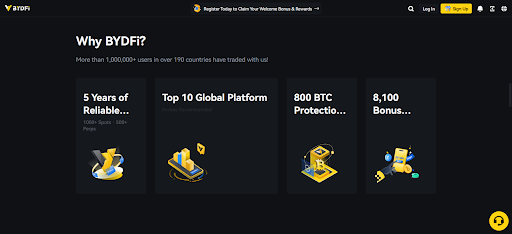
BYDFi’s security record is a clean slate: zero incidents since its 2020 launch. Its Proof of Reserves is independently audited by Hacken and publicly disclosed with specific asset ratios — BTC at 157%, ETH at 171%, USDT at 154% — confirming holdings significantly above user balance requirements. An 800 BTC Protection Fund, established in September 2025, is ring-fenced specifically for user asset protection. The Ledger hardware wallet partnership (February 2025) extends the security framework to cold storage for users who prefer self-custody. Withdrawal addresses are whitelisted and multi-party authorized, meaning outflows to unrecognized addresses require explicit user approval.
BYDFi’s fund is smaller in absolute terms. The operational track record is shorter. But five years without a single incident — while building a platform that now handles copy trading, on-chain access, and a Visa card — reflects a security posture that the incident history validates.
Crypto Cards: Both Offer Them, With Different Trade-offs
Both exchanges offer Visa cards for spending crypto at real-world merchants.
Binance’s card is primarily available in the European Economic Area and supports 14 cryptocurrencies. The headline feature is up to 8% BNB cashback — but this maximum rate requires holding 50+ BNB, which at current prices represents a commitment of around $30,000 or more. Most users see 1–3% effective cashback. The transaction fee is 0.9% above monthly free limits.
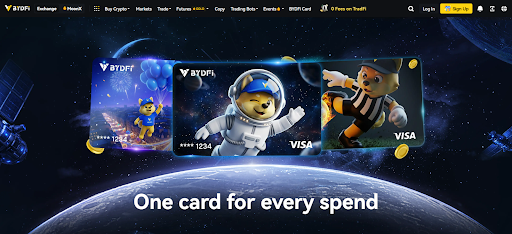
The BYDFi Visa Card, launched August 2025, targets global availability. It supports Apple Pay, Google Pay, and PayPal — the PayPal integration is a notable differentiator. The virtual card is free to issue. A $1 monthly fee applies, waived from VIP Level 2. The deposit conversion fee is 1%, and the forex fee is 0% for USD transactions. For users who want a crypto card without maintaining a large token balance to unlock its primary benefit, BYDFi’s simpler, lower-barrier structure is the more accessible option.
User Experience and Customer Support
Binance’s interface is feature-rich and has improved over the years, but it remains frequently cited as overwhelming for new users. The platform’s depth is one of its strengths and one of its friction points simultaneously. Binance Academy provides extensive educational content, and API uptime ran at 99.98% in H1 2025 with 1.8ms latency — genuinely impressive infrastructure numbers.
Customer support at Binance is a persistent concern. KYC delays, ticket resolution times, and support quality during high-traffic events (including the 10/10 crash) have generated significant user criticism. Trustpilot reviews reflect a mixed picture on support responsiveness.
BYDFi’s interface is more focused and easier to navigate for traders who do not need Binance’s full institutional product suite. The 50,000 USDT demo account allows meaningful testing before any capital is at risk. The new user welcome package of up to 8,100 USDT in bonuses reduces the cost of early-stage learning. The 24/7 human customer support, where reviewers consistently report connecting to a human agent within two minutes, is a concrete operational difference that matters in time-sensitive situations.
Pros and Cons
BYDFi
Pros:
- Triple-engine copy trading (Smart CEX, Same-Block MoonX, Smart Money Tracking) — no comparable system at this tier
- No mandatory KYC — trade immediately, withdraw up to 6 BTC/day without verification
- 200x leverage with no new-user restrictions (vs Binance’s 125x and 60-day 20x cap)
- MoonX: 500,000+ on-chain tokens with integrated 3-agency security scanning, directly from CEX account
- Zero security incidents since 2020; Hacken-audited Proof of Reserves above 100% for all major assets
- 50,000 USDT demo account (vs Binance’s 3,000 USDT)
- BYDFi Visa Card with Apple Pay, Google Pay, and PayPal — globally available
- 24/7 human support with documented 2-minute response times
- Newcastle United Premier League partnership; Forbes Top 10 and multiple 2025-2026 industry awards
- 1,000+ spot trading pairs — more than Binance’s spot catalog
Cons:
- Much smaller user base (1M vs 300M) — lower liquidity on major pairs
- No staking, earn, options trading, or margin products
- Futures taker fee (0.06%) is marginally higher than Binance (0.05%)
- Younger platform — five years of track record vs Binance’s eight
Binance
Pros:
- Unmatched liquidity — 41.68% global spot market share; minimal slippage on large orders
- $1 billion SAFU Fund — largest dedicated security reserve in the industry
- Broadest product suite — spot, futures, options, margin, Earn, Launchpad, Alpha 2.0
- 18+ regulatory licenses globally
- Aurora AI bot marketplace; Binance Academy educational resources
- 99.98% API uptime; 1.8ms latency
Cons:
- Mandatory KYC — cannot trade without identity verification; delays frequently reported
- 125x max leverage; new users capped at 20x for the first 60 days
- $4.3B DOJ/CFTC/Treasury settlement (November 2023); founder’s guilty plea
- October 2025 oracle crash — mass liquidations, stop-losses could not execute, compensation widely criticized
- 2% credit card deposit fee; 10% staking commission; BNB-dependent fee discounts
- Interface frequently cited as overwhelming for beginners
- Mixed customer support reputation at scale
- Binance Card primarily EEA; 8% cashback requires holding ~$30,000 in BNB
Who Should Choose Which?
BYDFi is the better fit if you want to start trading without uploading identity documents, you plan to use copy trading as a meaningful part of your strategy (especially same-block on-chain copy trading or smart money tracking), you trade memecoins or on-chain tokens and want integrated security screening before each trade, you want higher leverage without onboarding restrictions, or you place weight on fast and responsive customer support. The demo account and welcome bonuses also make it a more practical starting point for traders still building their approach.
Binance is the better fit if you execute large-volume trades that require deep order book liquidity, you need access to options trading, margin products, or structured earn solutions, you are a BNB ecosystem participant who benefits from token-based fee discounts and cashback, or you prioritize the broadest possible regulatory coverage and institutional product breadth.
Our Verdict
Binance is the world’s largest crypto exchange for real reasons. Liquidity, product depth, and regulatory breadth are genuine advantages for specific trader profiles — particularly high-volume institutional participants and BNB ecosystem users.
But the comparison reveals that Binance’s scale also comes with trade-offs: mandatory KYC that delays access, leverage restrictions for new users, fee structures that require token holdings to optimize, and an incident history that includes both a major regulatory settlement and a 2025 platform failure during extreme market conditions.
BYDFi has built a platform that performs well precisely on the dimensions where Binance is weakest. No mandatory KYC. Higher leverage with no onboarding gates. A triple-engine copy trading system that operates on a different technical level than standard copy trading. MoonX’s integrated on-chain access with built-in security scanning. A five-year clean security record backed by independently audited reserves. And customer support that reaches a human in two minutes, not two days.
For traders who prioritize privacy, on-chain access, copy trading depth, and a platform that has not faced the kind of systemic events Binance has dealt with in the past two years, BYDFi is the more capable choice. To explore the platform firsthand, you can read more on BYDFi’s official website, including the 50,000 USDT demo account that requires no deposit to access.
Frequently Asked Questions
Is BYDFi legitimate and safe?
Yes. BYDFi has operated since 2020 without a single confirmed security breach. Its Proof of Reserves is independently audited by Hacken, showing BTC at 157%, ETH at 171%, and USDT at 154% coverage — well above the 100% threshold. An 800 BTC Protection Fund provides an additional ring-fenced buffer. BYDFi was recognized by Forbes as a Top 10 Global Crypto Exchange and holds the Newcastle United official crypto exchange partnership.
Does BYDFi require KYC?
No. BYDFi does not require mandatory KYC. Users can register and begin trading immediately. Without verification, the daily withdrawal limit is 6 BTC. Optional KYC increases limits and unlocks features like the BYDFi Visa Card.
Is BYDFi better than Binance for futures trading?
It depends on your priorities. BYDFi offers up to 200x leverage with no restrictions for new accounts. Binance caps at 125x and limits new users to 20x for their first 60 days. Binance has deeper liquidity on major pairs and marginally lower taker fees (0.05% vs 0.06%). BYDFi’s triple-engine copy trading and MoonX on-chain futures tools give it a clear edge for traders focused on automated or on-chain strategies.
What is BYDFi MoonX?
MoonX is BYDFi’s on-chain trading engine, launched April 2025. It is integrated directly into the BYDFi platform interface and provides access to 500,000+ tokens on Solana and BNB Chain from a single account. Features include three-agency security scanning per token (GoPlus, Honeypot Detector, QuickIntel), same-block copy trading, smart money tracking, and automated risk management tools including anti-MEV protection.
How does BYDFi copy trading work?
BYDFi offers three copy trading engines: Smart Copy Trading for CEX perpetual contracts (starting from $10 minimum), Same-Block Copy Trading via MoonX (replicates on-chain trades within the same blockchain block for near-identical entry prices), and Smart Money Tracking (monitors and automatically replicates identified whale wallet activity on Solana and BNB Chain). Each engine has its own risk controls and can run simultaneously.
BYDFi vs Binance — which has lower fees?
Base spot fees are identical at 0.10% for both maker and taker. For futures, Binance’s taker fee (0.05%) is marginally lower than BYDFi’s (0.06%). However, Binance charges a 2% fee on credit card deposits and takes a 10% commission on staking rewards. BYDFi’s fee structure has no hidden costs or token dependencies. For most traders, the practical fee difference is minimal.
What happened to Binance in October 2025?
In October 2025, a USDe oracle vulnerability on Binance’s platform triggered a rapid BTC price crash from approximately $124,800 to $80,000. The event caused widespread liquidations. Users reported being unable to execute stop-loss orders during the crash. Binance’s subsequent compensation package was widely described as insufficient by affected traders. The event raised significant questions about platform reliability during extreme market conditions.
What is same-block copy trading?
Same-block copy trading is a BYDFi feature where on-chain copy trades are executed in the exact same blockchain block as the original trade from the lead trader. This eliminates the latency gap that causes standard on-chain copy trading to produce different entry prices for followers. It is available through BYDFi’s MoonX engine on Solana and BNB Chain, with anti-MEV protection built in.